Across Kerala, the Onam festival season brings a surge in demand for fresh vegetables and agricultural produce. For smallholding farmers, however, getting that produce to organised markets and achieving better price realisation has not always been easy.
At the same time, competition from neighbouring states, changing buyer dynamics and limited access to organised markets made it difficult for smallholding farmers to fully benefit from the demand their produce generated.
This Onam, the Department of Agriculture Development and Farmers’ Welfare, Government of Kerala, took a significant step towards addressing this challenge. The traditional Onam Market intervention was strengthened with a connected digital layer through KATHIR – Kerala Agriculture Technology Hub & Information Repository.
This created the KATHIR Onam eMarketPlace: a digital workflow that brought farmer identification, procurement, market operations, sales, payments, inventory and financial reporting onto a connected platform.
The Challenge: When Market Access Does Not Reach the Last Mile
For a smallholding farmer, producing a crop is only one part of the journey. The next challenge is finding the right market and getting a fair opportunity to sell. Kerala’s agricultural landscape includes a large number of small and marginal holdings. For these farmers, access to organised markets has traditionally involved physical processes, local coordination and extensive record-keeping. At the same time, Onam creates a significant seasonal demand for vegetables and other agricultural produce.
The opportunity was clear: create a structured market intervention that could bring smallholding farmers into the organised market system while also making quality produce available to consumers at reasonable prices.
The Department of Agriculture Development and Farmers’ Welfare introduced the Onam Market intervention to strengthen this market linkage and support better price realisation. However, for an intervention operating across a large number of markets, one challenge remained:
How do you bring consistency, visibility and accountability to lakhs of transactions happening across the ground?
That is where KATHIR became critical.
The Shift: From Physical Processes to a Connected Digital eMarketplace
KATHIR is designed as a digital platform for Kerala’s agriculture ecosystem, bringing together farmer information, agricultural services and data-driven workflows. Its broader objective is to create a connected ecosystem linking farmers, technology and agricultural institutions.
For the Onam Markets, KATHIR became the digital backbone of the market intervention. The KATHIR database helped identify smallholding farmers and bring them into the procurement process. Their produce, quantity and procurement details were digitally recorded. The procured produce then moved into the Onam eMarketPlace, where it could be made available for sale to citizens. This created a structured digital journey:
Farmer → Digital Procurement → Onam eMarketPlace → Citizen Purchase → Digital Sale → Financial Reporting
As a result, instead of individual market activities remaining disconnected, each stage became part of a traceable workflow.
The objective was making a physical market intervention more visible, more accountable and easier to manage at scale.
How the KATHIR Onam eMarketPlace Worked
The success of the intervention came from connecting the different roles involved in running an Onam Market. At the state level, market categories and allocations could be configured and monitored. District-level officials could manage pricing through the digital system. On the ground, Krishi Bhavans coordinated procurement and market operations with local stakeholders, including local bodies, to ensure that the markets functioned smoothly. The workflow brought these activities together digitally.
1. Identifying Farmers and Recording Procurement
The process began with the farmer. Farmers identified through the KATHIR ecosystem could bring their produce into the procurement process. The quantity and procurement details were captured digitally, creating a structured record of the produce entering the market. For farmers who did not have a KATHIR ID, temporary registration and help-desk support could facilitate participation in the market intervention. This helped extend the digital workflow closer to the last-mile farmer.
2. Moving Produce into the Onam eMarketPlace
The digital marketplace provided a structured view of available commodities, quantities and prices, enabling market officials to manage inventory and sales more efficiently. For citizens, the process remained simple: select the available produce and purchase it from the Onam Market. The technology worked behind the scenes to make the market operation more organised.
3. Digitising Sales and Payments
Sales were digitally recorded through the platform. Customers could pay through cash or UPI, while transactions were captured within the system. This meant that a sale was no longer simply a physical exchange at a market counter. It became a digitally recorded transaction linked to the market’s inventory and financial records.
4. Connecting the Market to Financial Accountability
The digital workflow extended beyond procurement and sales. Cash transactions could be captured through the e-Cashbook, while market-level information could feed into reporting and claim processes. This created visibility into the financial side of the intervention, from individual market activity to higher-level monitoring. The result was a connected chain from procurement to sale, inventory to transaction, and market activity to financial accountability.
Four Days. Statewide Scale. Measurable Impact.
The true test of any digital public infrastructure is not the technology itself. It is whether the technology works where it matters – on the ground, at scale, within the time available. The KATHIR Onam eMarketPlace demonstrated exactly that. Within just four days, the digital intervention supported Onam Markets across Kerala, reaching last mile farmers and facilitating more than 2 lakh customer transactions.
1,070+
Onam Markets
8,200+
Smallholding Farmers Sold Prduce
₹7.80 Crore+
Produce Procured
₹6 Crore+
Sales Revenue
2.05 Lakh+
Customer Transactions
These numbers represent more than platform activity. They represent thousands of individual market interactions brought into a common digital workflow, across farmers, Krishi Bhavans, market officials and consumers. This demonstrates what a connected agricultural digital platform can enable when technology, government processes and field-level execution come together.
Beyond Transactions: Bringing Transparency to the Market
One of the most important developments introduced through the KATHIR Onam eMarketPlace was visibility. Traditional physical market processes often depend heavily on paper records, manual entries and coordination across different levels. Digitisation does not eliminate the role of people on the ground. Instead, it gives them a common system through which their activities can be recorded, monitored and connected. With KATHIR, procurement, sales, inventory, payments, cashbook records, damage reporting, claims and market reports could be brought into the same digital ecosystem.
This meant greater:
Visibility across market operations.
Traceability across transactions.
Accountability across the intervention.
For administrators, this created a clearer view of market performance. For market officials, it reduced dependence on fragmented physical records. For the government, it enabled better visibility into procurement, sales and financial utilisation. And for farmers and consumers, it supported a more organised market environment.
From the Krishi Bhavan to the State Dashboard
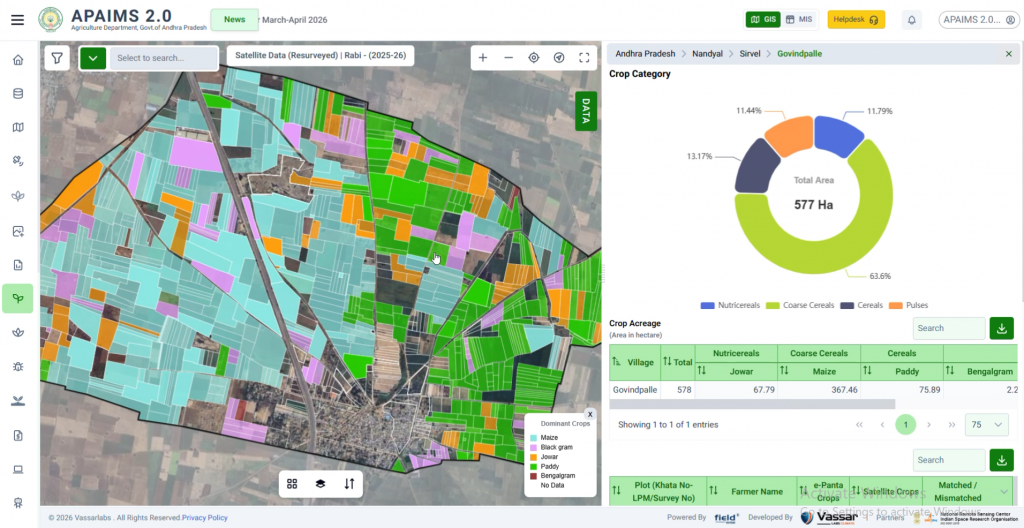
The Onam eMarketPlace was not designed as an isolated application at the market counter. It was a hierarchical digital workflow, connecting activity at the ground level to district and state-level visibility. Krishi Bhavans handled the operational realities of procurement and sales. District-level officials could manage pricing and monitor market activities. At the state level, dashboards provided an aggregated view of markets, procurement, sales, farmers, transactions and financial utilisation. This is where the larger value of KATHIR becomes visible. The same digital system that supports a transaction at a market can provide decision-makers with a consolidated picture of what is happening across the state. That is the essence of Digital Public Infrastructure for agriculture: connect the last-mile activity with the larger decision-making ecosystem.
Vassar Labs’ work across agricultural DPI follows this broader approach, using integrated digital platforms to connect farmers, field operations and government decision-making rather than treating individual technology solutions as isolated systems.
From Markets to eMarketplace
The success of the KATHIR Onam eMarketPlace is ultimately a story about making digital infrastructure work for people. For smallholding farmers, the platform creates a stronger pathway into an organised market intervention. Market officials benefit from simpler, more connected workflows, while administrators gain visibility from the market level to the state level. Consumers, meanwhile, gain access to produce through organised Onam Markets. And for the agriculture ecosystem, it demonstrates the potential of technology to strengthen the connection between farmer, market and consumer.
The Onam Markets may have operated for only four days. But the digital infrastructure created through KATHIR represents something much larger: a foundation for building stronger markets, better linkages and more accountable agricultural services. When digital infrastructure reaches the last mile, technology stops being just a platform. It becomes an enabler of better outcomes for farmers, markets and communities.
Further reading
Related on this blog: Precision Agriculture Explained · The Future of Fertilizer Distribution: From Supply-Driven to Need-Based · What Is Digital Public Infrastructure (DPI) for Agriculture?