Where the two layers meet
The interface between the layers is where most of the practical design work happens. Three touchpoints matter most.
Identity and eligibility. When a state scheme needs to confirm that an applicant is a cultivator with a given extent of land, the Farmer ID and linked land records are the obvious source. The PIB has cited Maharashtra’s use of AgriStack to transfer over ₹14,000 crore to 89 lakh farmers for Kharif 2025 crop losses within five days, and Chhattisgarh’s use of Farmer ID and crop survey data for MSP paddy procurement covering over 32 lakh farmers.
Crop data. The Crop Sown Registry gives state platforms ground-verified crop and area data each season. Satellite analytics can then extend and cross-check it between survey rounds, which is how plot-level crop health monitoring becomes possible.
Advisory channels. Nationally, the Union Budget 2026-27 introduced Bharat-VISTAAR, a multilingual AI tool integrating AgriStack portals with ICAR’s package of practices. State platforms can feed it state-specific context or connect their own advisory engines to it.
Where states retain the most control
The federated design is not a formality. Because registries are built and maintained by states, states control the quality and completeness of their own data, including decisions such as whether tenant farmers are included, which the Mission leaves to state policy. States also decide:
- which services to build, buy or open up to private providers;
- which state datasets, such as scheme beneficiary lists or soil tests, are linked to the Farmer ID;
- how field workflows are designed and who verifies what;
- the rules for sharing data with third parties within the national consent framework.
The government has also said AgriStack follows the Digital Personal Data Protection Act, 2023 and its 2025 Rules, with consent-based collection and access limited to authorised purposes. That sets the floor; a state’s own governance model sets how it operates in practice.
Common misreadings
“AgriStack replaces state platforms.” It does not provide state-specific services and was not designed to. It gives every state the same verified base to build on.
“A state platform can ignore AgriStack.” It can, but it will end up maintaining a parallel farmer database that disagrees with the national one, which is the fragmentation DPI was meant to end.
“Registering on one means registering on both.” Farmer ID creation happens through state Farmer Registry portals. Whether a state platform reuses that record or asks farmers to register again depends on how well the two are integrated, which is precisely the design choice worth getting right.
Where AgriStack Meets State-Level DPI Systems
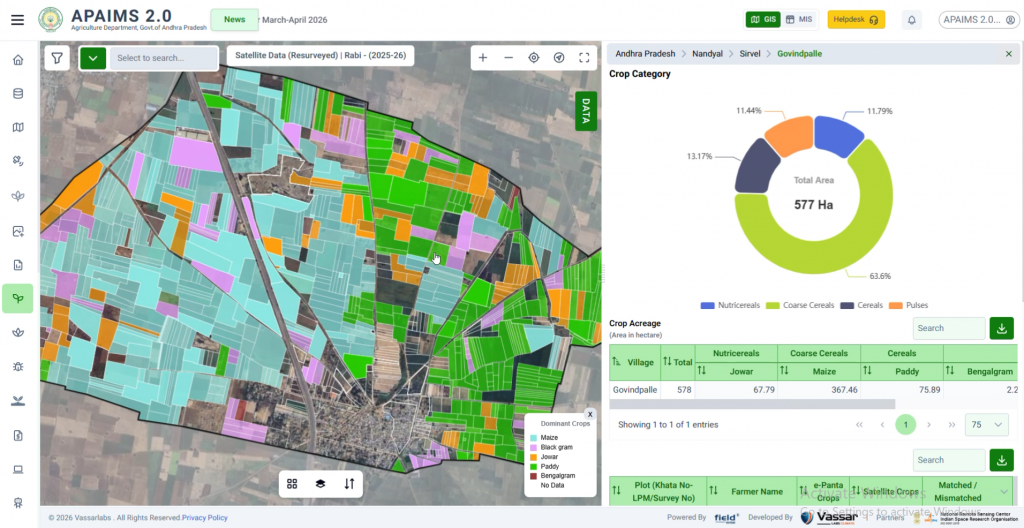
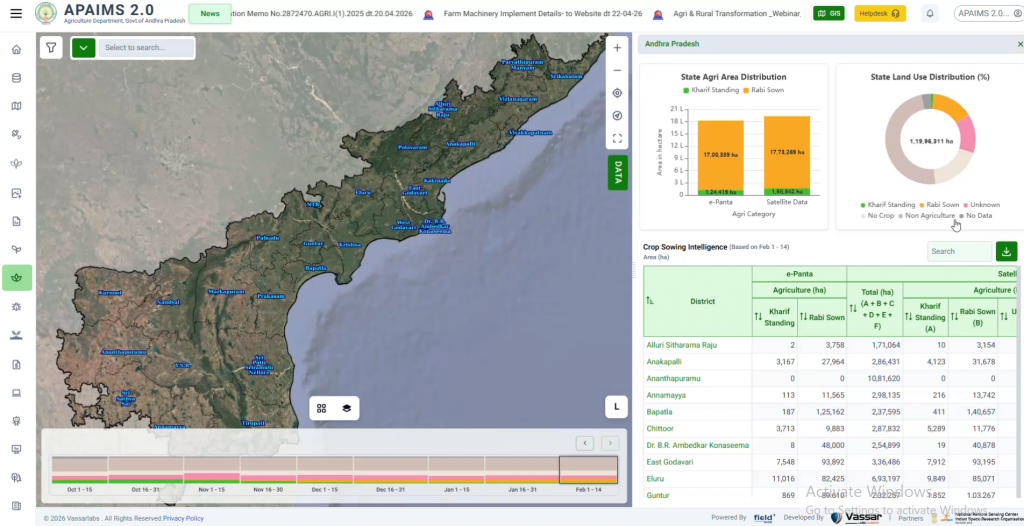
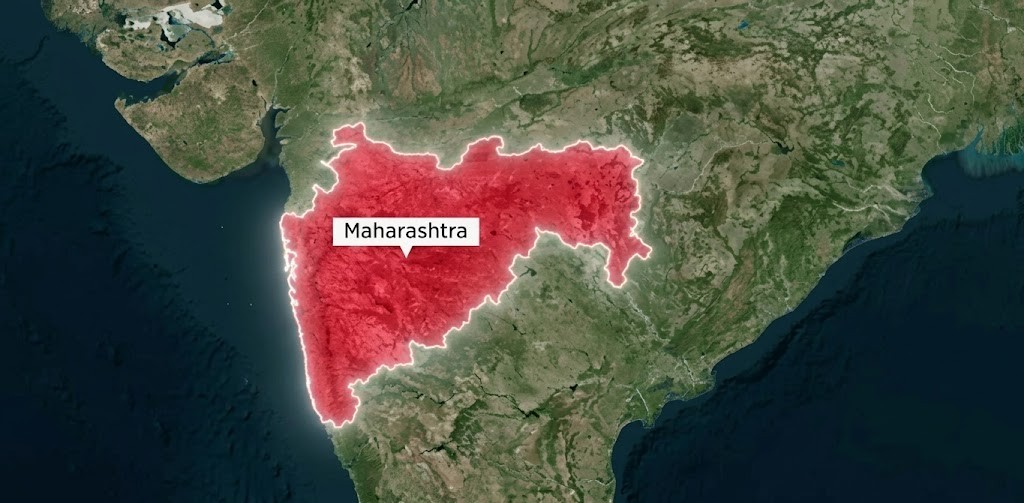
AgriStack gives every state the same verified base of farmer, land and crop records. What each state builds on top of that base differs, because it follows the state’s own crops, schemes and priorities. Three fieldWISE-based platforms (APAIMS in Andhra Pradesh, KATHIR in Kerala and MahaAgriNEX in Maharashtra) show how the service layer takes different forms on the same foundation.
Andhra Pradesh: APAIMS
The problem: India’s fertilizer subsidy regime has historically rewarded volume over precision. Over-application carries well-documented ecological costs, including soil acidification and nitrate leaching into groundwater. Fixing this meant knowing what each farmer actually grows and on how much land, at the point where fertilizer is sold.
The solution: APAIMS uses verified crop and extent data to set fertilizer entitlements for each farmer. Doses are customised by location, crop and extent, and sales cannot exceed what is dispensed against that entitlement. The same verified base also drives crop health monitoring and pest alerts for field officers.
- 2.3 crore+ verified land records for crop sown in the state
- 16,24,927 farmers transacted under the system in Kharif 2026-27, with 73,84,455 bags distributed
- Urea distribution down 28.6% and DAP down 43.3% versus last year (up to July)
- Aadhaar-based biometric or OTP authentication, with an auditable transaction history
- 10,000+ officer logins on the platform
- Before Cyclone Montha, mapped 6.23 lakh acres in its projected path and sent 69+ lakh targeted SMS alerts in local languages
Kerala: KATHIR
The problem: Festival seasons bring peak demand and sharp price swings, leaving farmers exposed to volatility and dependent on intermediaries. Kerala also needed one platform that connects national schemes with state-specific services.
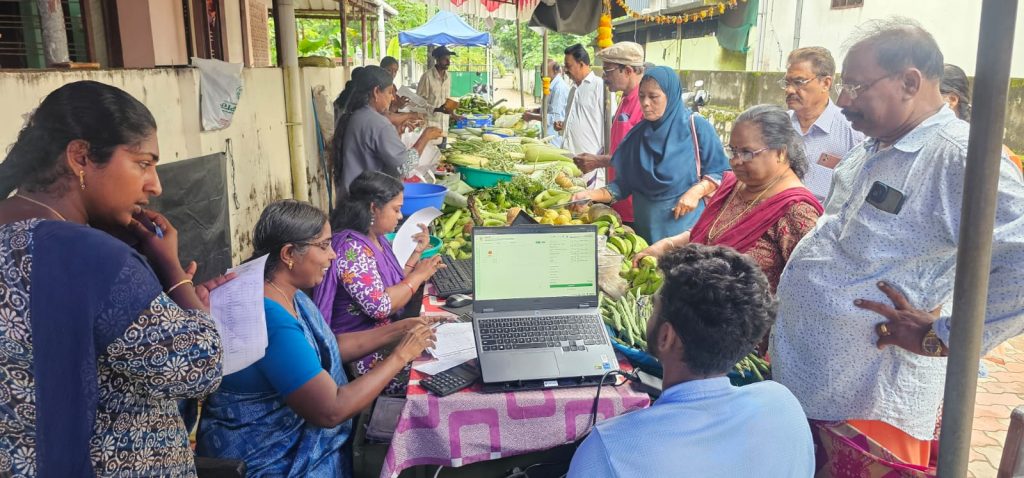
The solution: KATHIR aligns with PM-KISAN, PMFBY and the AgriStack Digital Crop Survey, and adds services specific to Kerala. For Onam, it powers a dedicated e-market module that gives farmers direct, fair-price access to buyers, handling operations digitally across cash and UPI.
- 21+ modules live, with 4,000+ agriculture officers actively using the platform
- 15.89 lakh farmer registrations and 70 lakh farm bund polygons generated
- Onam e-market so far: 8,244 farmers sold their produce, 1,93,596 customer transactions and ₹5.54 Cr in total sales
- NCDEX and ONDC integration in the e-marketplace
- 35+ soil testing labs on the platform
- Scheme application and monitoring for the Paddy Production Bonus
Maharashtra: MahaAgriNEX
The problem: A state as large as Maharashtra needs plot-level visibility into its farmland. Without farm boundaries, advisories and monitoring fall back on district averages. Maharashtra is also one of the states PIB cites for using AgriStack to move relief and procurement payments quickly, which makes a strong geospatial service layer on top of it all the more relevant.
The solution: MahaAgriNEX applies AI and satellite data to build that plot-level base statewide, running on the same data backbone as the other two platforms.
- 44,794 villages covered statewide
- 10 crore (~100 million) farm bund polygons generated
- Bund digitisation at over 90% accuracy across 26 Maharashtra districts
- 50+ government personnel trained and onboarded
Frequently asked questions
Who owns AgriStack data?
The registries are created and maintained by state governments and union territories within a federated architecture, with access governed by consent and authorised purpose.
Is AgriStack an app for farmers?
Not primarily. It is infrastructure: registries plus APIs. Farmers typically experience it through state portals, scheme applications and advisory services built on top.
Does every state need its own agri-DPI?
Every state needs a service layer. Whether it is built in-house, with a partner or by reusing shared components is a state decision.
Further reading
PIB: Cabinet approves the Digital Agriculture Mission
PIB: AgriStack’s Farmers Registry crosses 9.20 crore Farmer IDs
Related on this blog:What Is the Digital Crop Survey? · How Andhra Pradesh Built APAIMS