Why Dry Spells Matter More Than We Think
A dry spell is a prolonged period within the rainy season during which a location receives little or no effective rainfall, typically measured as consecutive days below a defined rainfall threshold. Unlike drought, which develops gradually over months or even years, a dry spell can emerge rapidly and disrupt agricultural operations within days.
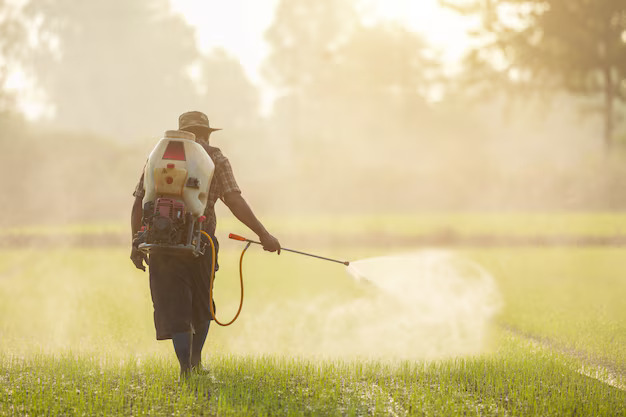
The timing of a dry spell often matters more than its duration. A two-week rainfall interruption during crop establishment can significantly reduce germination, delay sowing, increase irrigation demand, and ultimately lower yields, even if rainfall returns later in the season. Crops depend on a continuous supply of moisture during key growth stages, not simply on the final rainfall total recorded at the end of the monsoon.
This distinction is becoming increasingly relevant across India.
According to the India Meteorological Department (IMD), nearly 80% of India’s annual rainfall occurs during the southwest monsoon. However, rainfall distribution within the season varies considerably, with weekly rainfall frequently deviating by more than 100% from long-term averages. These fluctuations create alternating periods of intense rainfall and prolonged dry conditions, exposing agricultural systems to repeated moisture stress despite normal seasonal rainfall totals.
The Intergovernmental Panel on Climate Change (IPCC) highlights a similar trend, noting that rainfall across many regions is becoming increasingly concentrated into short-duration, high-intensity events. Instead of falling steadily throughout the season, rainfall is arriving in fewer but heavier bursts, leaving longer dry intervals between storms.
As rainfall becomes more erratic, understanding how often these interruptions occur becomes just as important as measuring total seasonal rainfall.
Looking Beyond Rainfall Totals
Traditional rainfall monitoring systems answer questions such as:
- How much rainfall has occurred?
- Is rainfall above or below normal?
- Which districts are currently experiencing rainfall deficits?
These indicators remain essential, but they capture only a snapshot of current conditions.
They cannot distinguish between a district experiencing its first dry spell of the season and another that has already endured multiple independent dry spell events, even though these locations may have very different levels of accumulated climate stress.
This is where Repeat Dry Spell Exposure provides a new perspective.
Rather than asking whether a location is dry today, Repeat Dry Spell Exposure asks a more meaningful question:
How many independent dry spell events has this location experienced during the current monsoon season?
Every completed dry spell leaves behind residual impacts. Soil moisture may recover only partially, groundwater withdrawals increase to compensate for rainfall shortages, reservoir inflows become more irregular, and crops become progressively less resilient. While a single dry spell may only delay agricultural activities, repeated interruptions gradually weaken the entire farming system.
In other words, climate stress is cumulative.
Why Repeated Dry Spells Matter
Consider two districts that have received exactly the same amount of rainfall.
District A experiences one dry spell early in the season before rainfall resumes normally. Soil moisture recovers, reservoirs replenish, and crop growth continues with limited disruption.
District B receives the same seasonal rainfall but experiences four separate dry spell events throughout the monsoon. Each rainfall interruption arrives before the landscape has fully recovered from the previous one. Soil moisture declines repeatedly, groundwater extraction increases to sustain irrigation, reservoir inflows become increasingly erratic, and crops face recurring water stress during successive growth stages.
By the end of the season, both districts may report identical rainfall totals.
Their agricultural resilience, however, is fundamentally different.
This cumulative exposure is precisely what conventional rainfall statistics fail to capture.
Tracking Climate Stress, One Dry Spell at a Time
Understanding Repeat Dry Spell Exposure requires far more than calculating seasonal rainfall totals. It demands continuous monitoring of rainfall patterns across millions of grid cells, identifying every dry spell event, tracking when it ends, and recording whether another independent event emerges later in the season. Performing this consistently across large geographies and throughout the monsoon is only possible through an intelligent, data-driven monitoring system.
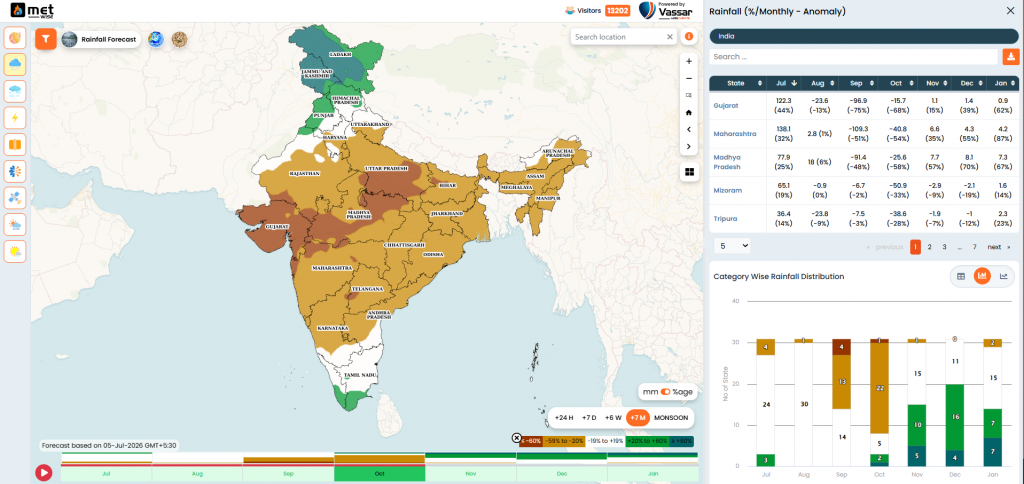
This is where metWISE, Vassar Labs’ AI-powered Digital Public Infrastructure (DPI) for Disaster Risk Management, transforms climate observations into actionable intelligence. By integrating gridded rainfall observations with geospatial analytics and AI-driven processing, metWISE continuously tracks dry spell evolution across India at a granular scale.
Within the platform, gridded rainfall observations are analysed daily to identify locations receiving 2.5 mm or less rainfall for at least 14 consecutive days, the operational threshold used to detect an active dry spell.
Detection alone, however, is only the beginning.
When sufficient rainfall breaks the dry period, that event is considered complete. If another qualifying dry period develops later in the season, a new independent event is recorded. Over time, this creates a complete seasonal history for every monitored location rather than a single snapshot of prevailing conditions.
This enables decision-makers to understand not only where dry spells are occurring, how long they have persisted, and how they are progressing spatially, but also how many independent dry spell events a location has already experienced during the current monsoon season.
The focus therefore shifts from asking, “Is this location dry today?” to asking a far more meaningful question: “How much cumulative climate stress has this location already experienced?”
Answering that question provides governments with an earlier, richer understanding of emerging agricultural and water stress, creating valuable lead time for timely intervention and proactive drought risk management.
From Climate Intelligence to Action
Repeat Dry Spell Exposure provides actionable intelligence across multiple government functions.
For agriculture departments, repeated dry spell events can trigger earlier irrigation advisories, support revised sowing recommendations, and activate crop contingency plans before yield losses become widespread.
For water resource managers, cumulative exposure helps anticipate reservoir inflow deficits, optimize canal release schedules, and manage groundwater extraction more efficiently in vulnerable regions.
For disaster management authorities, repeated dry spell events offer an early indication of emerging drought hotspots. Instead of responding after agricultural distress becomes visible, agencies can prioritize interventions while resilience still exists within the system.
For district administrations, repeat exposure maps help prioritize drinking water supply, village-level contingency planning, fodder management, and local resource allocation using objective climate intelligence rather than post-impact assessments.
Across all these functions, the greatest advantage is time.
Because Repeat Dry Spell Exposure captures cumulative climate stress before conventional drought indicators fully emerge, governments gain valuable lead time for proactive intervention rather than reactive response.
Transforming Repeat Dry Spell Exposure into an operational decision-support capability requires continuous integration of multiple data sources, advanced analytics, and scalable computing.
metWISE combines IMD gridded rainfall observations, numerical weather prediction models, satellite Earth observation, hydrological modelling, artificial intelligence, and geospatial analytics into a unified climate intelligence platform.
The platform continuously monitors more than a dozen weather and climate hazards, including floods, cyclones, heatwaves, lightning, heavy rainfall, drought indicators, and dry spells, through a single operational interface.
Within this ecosystem, the Dry Spell Monitoring module continuously evaluates rainfall patterns across India, detects new dry spell events, tracks their progression, and maintains a cumulative seasonal history for every monitored grid cell. Decision-makers can visualize active dry spells, consecutive dry days, district-wise and state-wise exposure patterns, and, most importantly, the number of independent dry spell events that have occurred throughout the season.
Instead of presenting static weather maps, metWISE reveals how climate stress is evolving over time, enabling governments to act before isolated rainfall interruptions escalate into large-scale agricultural or water security crises.
Towards Proactive Drought Risk Management
Dry spell frequency is not intended to replace established drought indicators such as the Standardized Precipitation Index (SPI), Standardized Precipitation Evapotranspiration Index (SPEI), soil moisture anomalies, or reservoir storage assessments. These indicators remain indispensable for understanding long-term drought conditions.
Instead, Repeat Dry Spell Exposure complements them by capturing a dimension that traditional indicators often overlook, the cumulative impact of repeated rainfall interruptions during the crop growing season.
As climate change continues to alter the timing, intensity, and distribution of rainfall, governments require decision-support systems that move beyond measuring rainfall totals alone. They need climate intelligence capable of revealing how resilient or vulnerable, a landscape has become long before conventional drought declarations are triggered.
By integrating Repeat Dry Spell Exposure into a nationwide, AI-powered Digital Public Infrastructure, metWISE enables governments to transition from reactive drought response to proactive climate risk management. Earlier insights translate into earlier decisions, better resource allocation, and stronger protection for agriculture, water resources, and vulnerable communities.
Because in a changing climate, resilience is determined not only by how much rain falls, but by how many times people, crops, and ecosystems are forced to recover between the storms.