Extreme heat has quietly become one of the deadliest climate risks of our time, killing an estimated 489,000 people every year between 2000 and 2019, with nearly half of these deaths occurring in Asia (source: WHO). At the same time, recent research shows that 37% of heat-related deaths are already attributable to human-induced climate change, and heat mortality among people over 65 has risen by about 70% in just two decades. This is no longer a distant climate scenario; it is a lived reality shaping public health, productivity, and infrastructure today.
Yet in many parts of the world, including India, operational responses to heat still revolve around reactive temperature thresholds – issuing warnings only when observed maximum temperatures cross fixed limits. This approach is increasingly misaligned with how heat risk actually unfolds on the ground. It waits for the danger to materialise instead of anticipating it.
Across climate-vulnerable regions, governments are now recognizing the need for a heatwave early warning system that can detect rising risks before they become emergencies. In India specifically, there is a growing push for better heatwave alerts India systems that can provide early intelligence to administrators, health departments, and communities.
This blog explains why early, predictive, and hyper-local heatwave alerts must now take precedence over simple temperature thresholds, and how Vassar Labs’ metWISE Heat Watch system operationalises this shift for India by combining India Meteorological Department (IMD) and 2 weeks of ECMWF forecast datasets, multi-day forecasts, and district-to-block level intelligence.
The traditional temperature-threshold model
Most heatwave action plans and warning systems around the world, including in India, are built around temperature thresholds. Typical elements include:
- Defining a heatwave when maximum temperatures exceed a climatological normal by a certain margin or cross an absolute threshold for consecutive days.
- Issuing colour-coded alerts (yellow, orange, red) once observed temperatures exceed those limits.
- Recommending reactive measures such as changing school timings, opening cooling centres, or advising the public to avoid outdoor exposure during peak hours.
This approach is closely tied to temperature threshold heatwave definitions used by meteorological agencies. While useful for standardisation, these thresholds often fail to capture how heat risk actually builds over time.
This model made sense when heatwaves were rare outliers and when observational infrastructure, computing power, and high-resolution data were limited.
Where the traditional model falls short
However, the threshold-based approach has structural limitations in a climate-constrained world:
- It reacts to realised heat, not emerging risk. By the time observed temperatures cross a threshold, vulnerable populations may already have been exposed for several days, particularly in compound events where high humidity and night-time temperatures reduce recovery time.
- It often ignores humidity and heat index. Human heat stress depends not only on air temperature but also on humidity. Advanced heat index monitoring is therefore essential to understand how hot conditions actually feel to people.
- National or state-level thresholds may not capture microclimates driven by urban heat islands, land-surface characteristics, or local geography. Communities a few kilometres apart can experience very different actual heat stress.
- It under-serves operational decision-makers. District administrations, health departments, and education officials need lead time to reschedule exams, mobilise health staff, stock medical supplies, or plan water distribution. A warning that arrives only when thresholds have already been exceeded compresses this decision window.
In short, temperature thresholds tell us when we are already in trouble; they rarely tell us when trouble is building.
Why early, risk-based alerts matter more than static thresholds
Heat risk does not increase linearly with temperature. Once a combination of temperature, humidity, exposure duration, and vulnerability crosses certain physiological and infrastructural tipping points, mortality and disruption can spike dramatically.
Modern climate intelligence platforms now use predictive models, forecast data, and heatwave forecasting techniques to detect risk earlier. These systems represent a major advancement in extreme heat early warning capabilities.
Early alerts based on short- to medium-range forecasts, historical patterns, and indices such as the heat index and land-surface temperature change the paradigm in three important ways:
- They extend the decision window, giving authorities and communities several days to plan around peak heat periods.
- They localise the risk, allowing near-real-time differentiation between districts and even sub-district blocks experiencing normal, heatwave, or severe heatwave conditions.
- They support more sophisticated heatwave risk management strategies across sectors, such as schools, healthcare facilities, and Anganwadi centres, enabling targeted interventions where they are most needed.
From temperature to impact: what authorities actually need
For a district collector, health officer, or education department official, the operational questions are not just “What is tomorrow’s maximum temperature?” but:
- Which specific blocks will be in heatwave or severe heatwave conditions over the next 3–7 days?
- How many schools, primary health centres, and Anganwadi units fall within those high-risk zones?
- How accurate have recent forecasts been for my jurisdiction, and can I safely base decisions on them?
- Can I quickly generate advisories and MIS-style reports to coordinate with line departments?
Answering these questions requires advanced climate risk analytics that combine meteorological data with administrative and infrastructure datasets.
This is the gap Vassar Labs deployed metWISE to fill.
metWISE Heat Watch: operationalising early heat intelligence for India
metWISE, powered by Vassar Labs, is a climate and weather intelligence platform that includes a dedicated Heat Watch module covering three key dimensions of heat risk:
- Heatwaves
- Heat index (combining temperature and humidity to better reflect perceived heat stress)
- Land Surface Temperature (LST), capturing how different land covers – urban, rural, vegetated, bare soil, amplify local heat conditions
- Feel like temperature
As an advanced heatwave intelligence platform, metWISE is designed to help governments move from reactive alerts to proactive forecasting.
Within this module, the Heatwave Watch capability enables high-resolution heatwave monitoring system capabilities that provide continuous insight into evolving heat risks.
The Heatwave Watch module uses authoritative datasets from the IMD-GFS and ECMWF to combine 2 days of historical observations with 7 days of forecast data for heatwave conditions.
For any selected reference date, the system presents:
- Observed data from the previous three days
- Forecasted heatwave conditions for the upcoming seven days
Granularity from national to block levels
A defining strength of metWISE Heat Watch is its ability to drill down from an all-India view to state, district, and mandal/block-level insights.
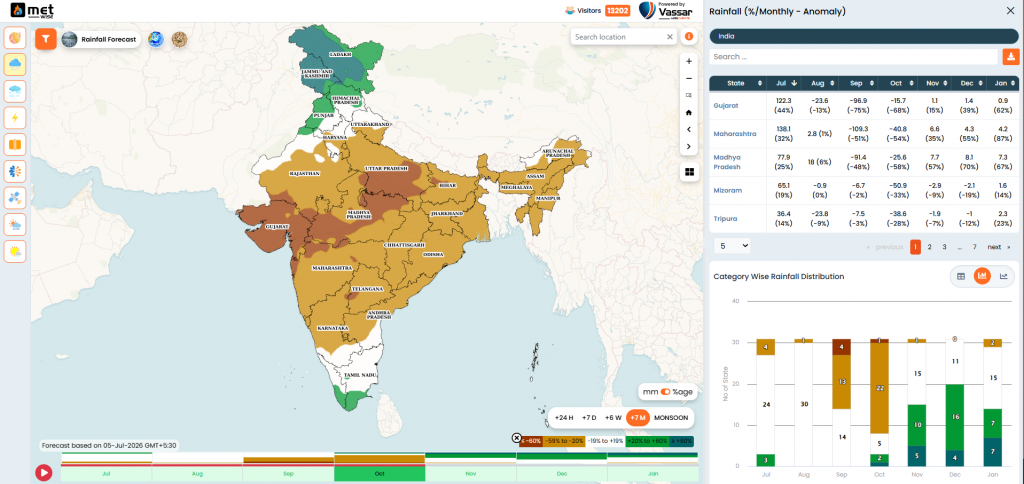
- At the national level, users can visualise the spatial spread of heatwave and severe heatwave conditions across India.
- At the state and district levels, the system highlights which districts are under heatwave (often represented in orange) and severe heatwave (typically in red) conditions over time.
- At the mandal or block level, users can explore detailed forecasts and observed data, seeing how risk varies within a district.
This approach reflects a new generation of climate resilience technology, where climate intelligence is directly connected to governance and disaster preparedness systems.
Forecast accuracy analytics
To address this, metWISE Heat Watch includes built-in forecast accuracy validation by systematically comparing predicted values with observed data.
The platform computes forecast accuracy as:
- Number of correct forecasts (where predicted values match observed conditions within defined tolerances)
- Divided by total forecasts
- Expressed as a percentage
This accuracy metric is surfaced in the interface, so decision-makers can see how well the model is performing for their geography and time window. Over time, such transparency helps build institutional confidence in using 3–7 day early alerts as the basis for high-stakes decisions.Such transparency improves trust in predictive heatwave forecasting models and allows authorities to confidently act on early alerts.
MIS-style views and category-wise distribution
Beyond maps, metWISE Heat Watch provides an MIS (Management Information System) view, presenting tabular summaries such as:
- Total number of districts in severe heatwave, heatwave, and normal categories
- Overall forecast accuracy for the selected period
- Drill-down statistics for specific districts, mandals, and facilities
This dual view – spatial on the left, tabular on the right – allows both operational staff and senior officials to quickly grasp the situation, filter to areas of concern, and export information into existing workflows.
An advisory report for heatwaves can be downloaded directly from the module’s interface, aiding rapid communication with line departments and field teams.
Turning early alerts into sector-specific action
Early alerts only create value if they are translated into sector-specific actions. metWISE Heat Watch is designed with this in mind, providing tailored drill-downs and alert capabilities for schools, healthcare facilities, and Anganwadi centres.
School alerts: protecting children and learning continuity
Within the Heatwave module, administrators can:
- Drill down from a district to individual mandals.
- Activate the School Alert layer to see how many schools fall under heatwave and severe heatwave conditions over the selected period.
- Use the MIS view to list schools in each risk category, with filters and search to quickly locate specific institutions.
For any given school, metWISE presents rich metadata such as school type, school code, district, block, village, pincode, latitude–longitude coordinates, and the associated heat alert status.
This enables:
- Evidence-based decisions on shifting to morning-only classes or remote learning during peak heat.
- Prioritisation of cooling and hydration support (e.g., water supply, fans, shaded areas) for schools in red (severe heatwave) zones.
- Targeted communication with parents and local communities.
A downloadable advisory specific to the heatwave situation further streamlines coordination between education departments and district administrations.
Healthcare alerts: preserving surge capacity
Health systems are among the first to feel the strain of extreme heat. The Heatwave module supports healthcare-specific drill-downs by enabling users to:
- Move from district to mandal level and turn on the Healthcare Alert layer.
- Identify how many healthcare facilities – primary health centres, community health centres, hospitals, are in heatwave and severe heatwave zones.
- View facility-level details such as district, sub-district, locality, landmark, facility ID, and current alert status.
This granular intelligence helps health authorities to:
- Pre-position IV fluids, cooling equipment, and additional staff in facilities likely to face heatstroke and dehydration cases.
- Coordinate ambulance and referral pathways between facilities in different risk zones.
- Monitor how forecasted risk evolves over the coming days and adjust surge plans in near-real-time.
Again, advisory reports can be downloaded to support rapid dissemination of instructions to frontline health workers.
Anganwadi alerts: safeguarding early childhood and maternal health
Anganwadi centres serve some of the most vulnerable populations – young children and pregnant or lactating women. The Heatwave module includes a dedicated **Anganwadi Alert** capability that allows users to:
- Drill down from district to mandal level and overlay Anganwadi locations on top of the heatwave severity map.
- Identify which Anganwadi units are in heatwave and severe heatwave zones.
- Access details such as mandal name, Anganwadi ID, Anganwadi name, and the current heat alert status.
This enables social welfare and Women & Child Development departments to:
- Adjust timings of Anganwadi operations to cooler hours.
- Organise additional hydration, nutrition, and shade for children and caregivers in high-risk areas.
- Temporarily consolidate services or shift activities indoors in severe heatwave hotspots.
As with schools and healthcare facilities, Anganwadi-specific advisories can be downloaded with a single click, ensuring that early alerts translate into operational micro-decisions that save lives.
Why metWISE-style early alerts must precede temperature thresholds
The case for prioritising early heatwave alerts over mere temperature thresholds is now compelling, especially in a country like India where heat risk intersects with high population density, informality of work, and infrastructural constraints.
Systems like metWISE Heat Watch offer several critical advantages:
- Lead time: By integrating 2 days of historical observations with 7 days of IMD forecasts, authorities can act before thresholds are breached, not after.
- Granularity: State, district, and mandal/block-level intelligence recognizes that vulnerability is hyper-local, not uniform.
- Sector linkage: Explicit overlays for schools, healthcare facilities, and Anganwadi centres connect meteorology to concrete public-service decisions.
- Transparency: Built-in forecast accuracy metrics build trust and enable continuous improvement of models and response protocols.
- Actionability: Integrated MIS views and one-click advisory downloads bridge the gap between analytics and field execution.
Looking ahead: building resilient heat governance
As global and national institutions – from the WHO and World Bank to the IPCC – continue to warn about the escalating risks of extreme heat, the governance challenge is increasingly about operationalising foresight. For India, where heatwaves are expected to become more frequent, intense, and prolonged, this means:
- Moving from threshold-triggered advisories to forecast-driven, risk-based early alert systems.
- Embedding platforms like metWISE into state and district heat action plans, disaster management protocols, and sectoral standard operating procedures.
- Training officials across education, health, rural development, and urban governance to interpret and act upon heatwave intelligence.
- Continuously improving data quality, model accuracy, and user experience based on feedback from the field.
Heatwaves will not wait for policy cycles or budget years. But with tools such as metWISE Heat Watch, authorities can ensure that early alerts – not late thresholds – become the backbone of India’s response to extreme heat, protecting lives, livelihoods, and development gains in an increasingly warming world.